




Description
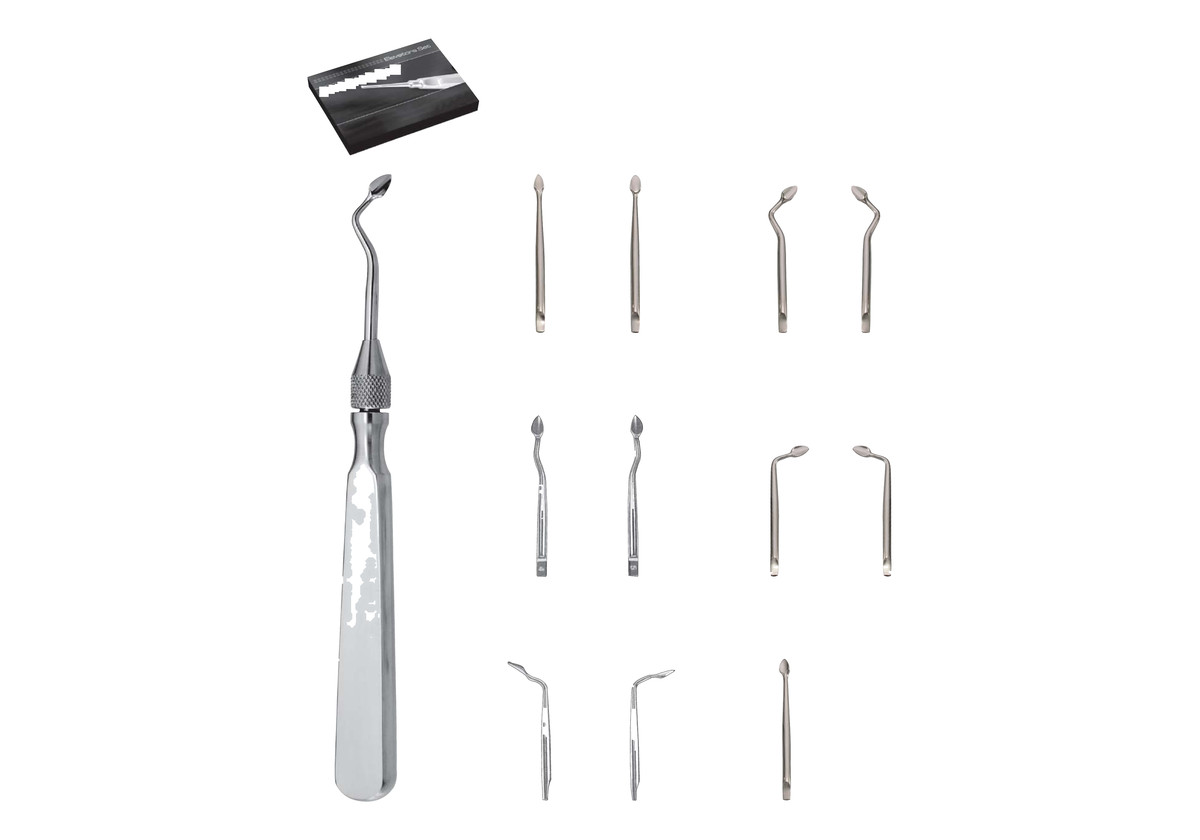
Syndesmotomes Root Elevators Set of 12 Pieces
A 12 piece syndesmotome set lets you cut the ligament around almost any tooth before you elevate. Syndesmotomes have sharp, thin blades. They sever the fibers so the tooth can move with less force.
Why cut the ligament first
The ligament holds the root to the bone. When you sever it first, elevators and forceps often need less force. As a result, many clinicians use a syndesmotome as the opening step of an extraction.
Straight, angled and curved
The kit groups its blades by shape. Fig. 0, 1 and 2 are straight. Fig. 3, 4 and 5 add an angle. Then Fig. 6, 7, 8 and 9 add a curve to follow the root surface. Finally, Fig. 11 gives posterior reach.
The short 11 cm pattern
One piece uses a short 11 cm pattern. A shorter instrument can feel easier in a small mouth or near the front teeth. So it adds a compact option to the larger range.
How the blades work around a tooth
Insert the blade into the ligament space. Then move it around the root with small strokes. Hold the edge on the root surface and away from the gingiva. Finally, switch shapes as you go around the arch.
Matching shape to site:
- Front teeth: straight Fig. 0 to 2 or the short pattern
- Premolars: angled Fig. 3 to 5
- Curved roots: Fig. 6 to 9
- Back of the arch: Fig. 11
Twelve, eight or four?
Our eight-piece kit focuses on angled, curved and posterior blades. The Chompret kit offers four. By contrast, the 12 piece syndesmotome set covers the widest range, so it suits a busy surgical room.
Ordering the twelve-blade kit
Each of the twelve syndesmotome blades carries three years against manufacturing defects, so we, not you, pay for a faulty syndesmotome tip. The stainless steel meets ASTM F899. All twelve ship non-sterile and turn reusable after cleaning and sterilization. For a smaller line-up, see the eight-piece syndesmotome kit. You may also browse clinical and institutional sets or find answers in our FAQ.
Professional use only. Sharp edges need care, so read the reprocessing steps and shipping notes.
What is in the set
| Instrument | Typical use |
|---|---|
| Syndesmotome, short 11 cm pattern | Compact ligament cutting |
| Syndesmotomes Fig. 0, 1, 2 straight (3 pieces) | Anterior and direct-line sites |
| Syndesmotomes Fig. 3, 4, 5 angled (3 pieces) | Premolar and angled access |
| Syndesmotomes Fig. 6, 7, 8, 9 curved (4 pieces) | Following curved root surfaces |
| Syndesmotome Fig. 11 | Posterior reach |
| Storage case | Holds and protects the set between cases |

Reviews
There are no reviews yet.