




Description
Standard Dissecting Thumb Forceps
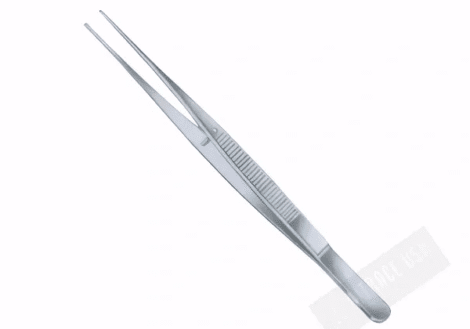
A thumb forceps is the instrument you hold like a pencil. There is no ratchet and no ring handle. Two arms joined at one end open by spring tension and close under finger pressure, so grip is applied and released continuously rather than locked. That is what makes it the instrument of choice for the hundreds of small manipulations in a case that never need a locked hold, which is why most teams keep several lengths open on the tray at once.
Choosing the jaw: serrated or 1:2 teeth
This is the decision that matters, and it is not a preference.
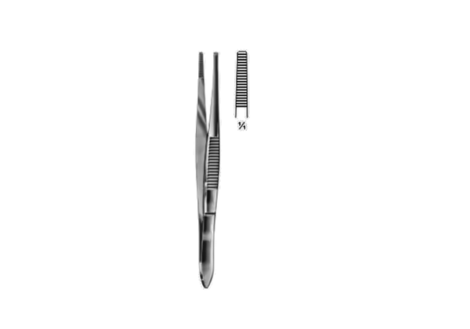
Serrated jaws grip by friction across the whole face of the tip. Pressure is spread, and nothing penetrates the tissue. Use them where a puncture would be a problem, on bowel, vessels and delicate structures, and for the non-tissue work that fills a case: moving swabs, positioning dressings, picking up a suture needle.
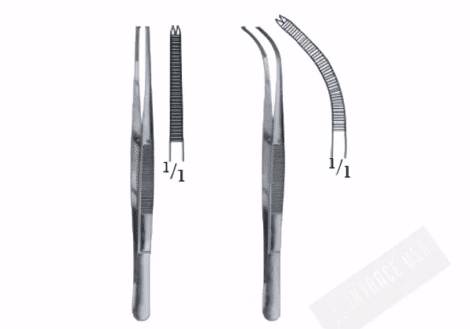
1:2 teeth put a single tooth on one jaw meeting a pair on the other, so the jaws interlock. The hold comes from that interlock rather than from squeezing, which means tough tissue is held securely with far less crushing force than serrated jaws would need to achieve the same thing. Use them on skin, fascia, scar and dense connective tissue.
The working rule: teeth on tissue that will be excised or closed at a full thickness edge, serrated on tissue that must not be perforated.
Choosing the length
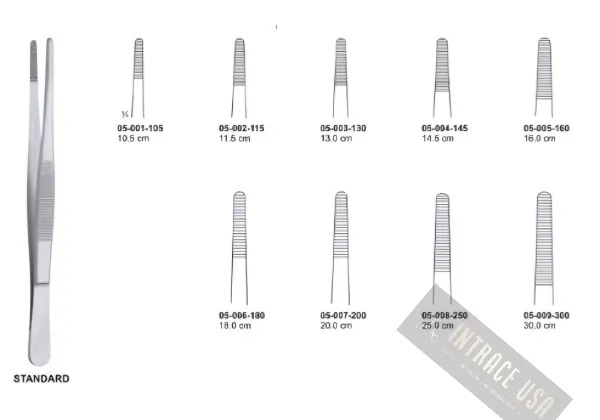
Both patterns run from 10.5 cm to 30 cm. Short lengths give the most control for superficial and fine work, with the hand resting close to the field. Longer lengths reach into a deep cavity while keeping the hand and wrist out of the line of sight, which matters more than tip precision once you are working at depth.
Specification
- Nine lengths: 10.5, 11.5, 13, 14.5, 16, 18, 20, 25 and 30 cm
- Two jaw patterns: fully serrated, or 1:2 teeth
- Surgical stainless steel, single piece, no hinge or box joint
- Reusable and autoclavable, supplied non-sterile
- Priced per instrument, not per pair
Care and handling
With no hinge and no box joint there is nowhere for debris to hide, so cleaning is simpler than on a ringed instrument. Wash with a neutral pH detergent, paying attention to the serrations or between the teeth, rinse, dry and autoclave to your facility’s validated cycle. The one thing to inspect is tip alignment: close the jaws under light pressure and check they meet cleanly along their full face. A forceps whose tips have been sprung or crossed will not hold, and no amount of grip will compensate. Store flat rather than loose in a drawer, where the tips get bent.
Warranty
Each instrument is checked in the United States before it leaves us, tips closed to confirm they meet correctly. Intrace USA covers this forceps for three years against manufacturing defects and replaces any that fails within it.
Browse our other dressing and tissue forceps, or see the FAQs for ordering, bulk pricing and care.
Images are for reference. Supplied non-sterile for professional use.

Reviews
There are no reviews yet.