




Description
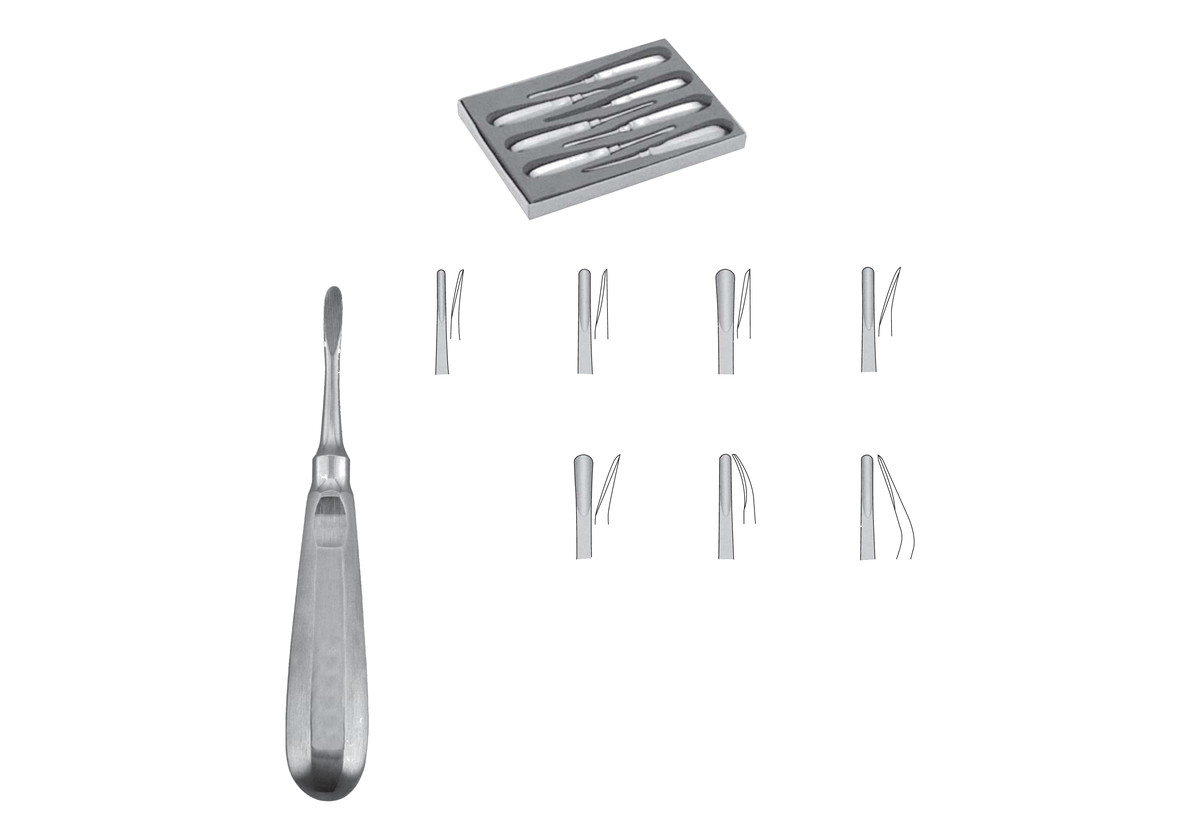
Luxation Elevator Set, 7 Pieces
Our luxation elevator set holds seven thin blades for periotomy and luxation. The idea is to cut the ligament first, then loosen the tooth. That way you place less load on the bone than with heavy prying.
Why periotomy comes first
The ligament holds a tooth in its socket. When you cut those fibers, the tooth moves more freely. As a result, the socket walls take less stress. Many clinicians use this step when they plan an implant or graft later.
Seven blades, three widths
The set runs from fig. 1 to fig. 7. Also, widths are 2, 3 and 5 mm, with several 3 mm options. Some ends are straight and some are curved. So you can follow a root line on both front and back teeth.
Working with thin blades
- Use light, steady pressure along the root.
- Move around the tooth in small steps.
- Avoid using a thin blade as a heavy lever.
- Check the edge before each case.
Which seven-piece kit to buy
We stock a few thin-blade sets. This one focuses on periotomy with mixed straight and curved ends. If you prefer named shapes such as spade or mesial, our tip-shape set may suit you more. Either way, all of them aim at gentle luxation.
A full run in one box
Thin blades wear with use, and roots vary. Therefore, it helps to keep a full run on hand. A single order also gives you a common grip across all seven.
Steel, inspection and help
We choose stainless steel that matches ASTM F899. The design is ours, and the finished set passes inspection in the United States. It is non-sterile when it arrives; clean and sterilize it, and it is reusable. Coverage is three years against manufacturing defects for every blade. For bigger reach, look at the straight, angled and bayonet kit. Also see our institutional catalog and our buyer FAQ.
Only for professional users. Visit our reprocessing tips and delivery details first.
What is in the set
| Instrument | Typical use |
|---|---|
| Luxation elevator fig. 1 (2 mm) | Narrow entry for periotomy |
| Luxation elevator fig. 2 (3 mm) | Periotomy and luxation |
| Luxation elevator fig. 3 (5 mm) | Wider roots |
| Luxation elevator fig. 4 (3 mm) | Periotomy and luxation |
| Luxation elevator fig. 5 (5 mm) | Wider roots |
| Luxation elevator fig. 6 (3 mm) | Following curved roots |
| Luxation elevator fig. 7 (3 mm) | Following curved roots |
| Sterilization cassette | Keeps the set together through cleaning, sterilization and storage |

Reviews
There are no reviews yet.