




Description
Luxating Root Elevator Set, 7 Pieces
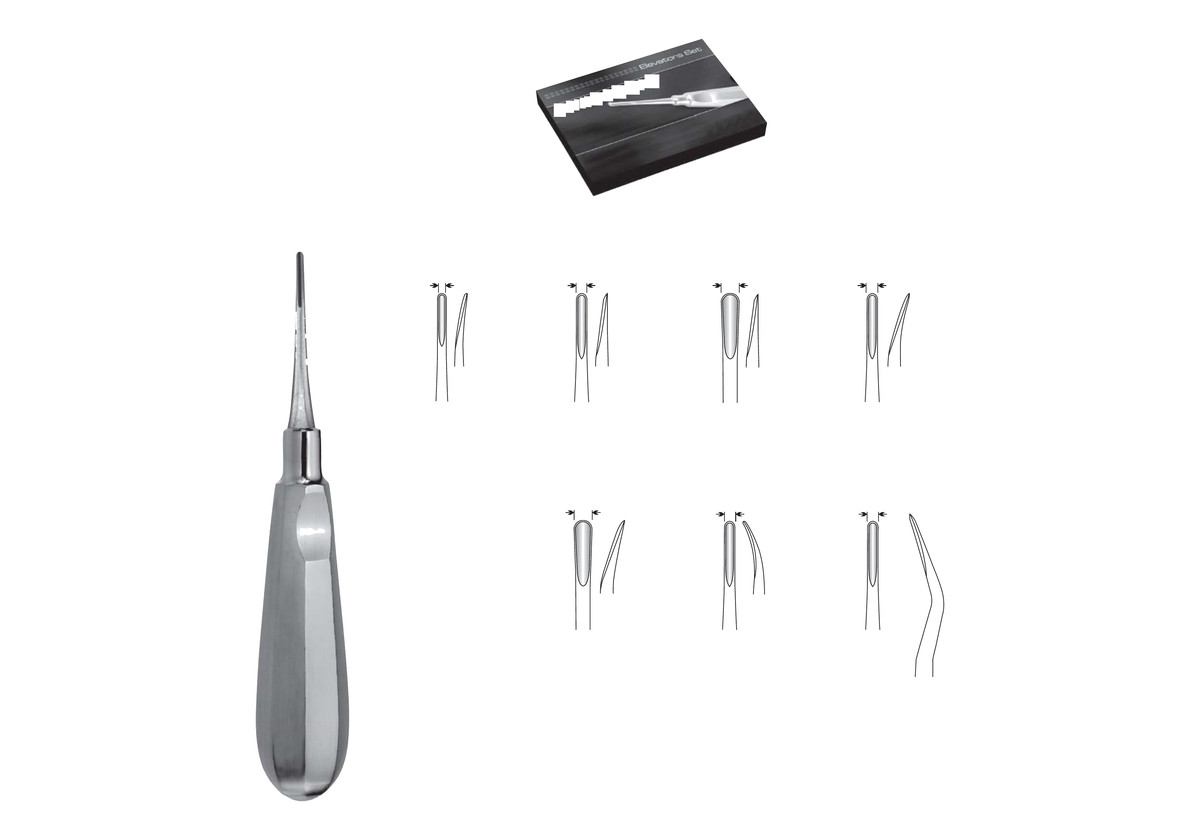
These seven luxating elevators have thin, sharp blades for cutting the periodontal ligament. Rather than prying, you slide the blade down the root to sever fibers. So the tooth loosens with less force on the bone around it.
How a thin blade changes the approach
A classic elevator works as a lever. By contrast, a luxating blade works more like a fine wedge and cutter. You guide it into the ligament space, then rock it with light pressure. Because the edge is sharp, it suits cases where you want to spare the socket walls.
Widths and shapes in the seven
First, Fig. 1 is the narrowest at 2 mm. Then Fig. 2, Fig. 4, Fig. 6 and Fig. 7 each run at 3 mm. Fig. 3 and Fig. 5 step up to 5 mm. Also, the set mixes straight and curved ends, so you can follow the curve of a root on front or back teeth.
Tips for daily use
- Hold the handle in your palm with a finger near the tip for control.
- Work around the root in small steps instead of forcing one spot.
- Also, store blades so the edges stay sharp.
Picking between our thin-blade kits
We list more than one set of this type. This one follows the Fig. 1 to Fig. 7 sequence by blade width. However, if you prefer shapes such as spade, mesial and distal, look at our tip-shape version instead.
The case for a full sequence
After all, roots vary, and one size rarely suits all. With all seven luxating elevators on hand, you can step up or down without waiting. In addition, one order keeps the handles alike.
Quality and support
As for material, all blades use stainless steel to ASTM F899. Our team sets the specification, and the set passes inspection in the United States. The seven-piece elevator set reaches you non-sterile; afterward, you clean, sterilize and reuse it. If a defect from production appears, the remedy is on us for three years against manufacturing defects. Also see the tip-shape luxating kit, the wider range of institutional sets, and our FAQ section.
Only for use by dental professionals. Find cleaning advice here, and see how we ship.
What is in the set
| Instrument | Typical use |
|---|---|
| Luxating elevator Fig. 1 (2 mm) | Narrow roots and tight spaces |
| Luxating elevator Fig. 2 (3 mm) | General ligament cutting |
| Luxating elevator Fig. 3 (5 mm) | Wider roots |
| Luxating elevator Fig. 4 (3 mm) | General ligament cutting |
| Luxating elevator Fig. 5 (5 mm) | Wider roots |
| Luxating elevator Fig. 6 (3 mm) | Curved access around roots |
| Luxating elevator Fig. 7 (3 mm) | Curved access around roots |
| Storage case | Holds and protects the set between cases |

Reviews
There are no reviews yet.