




Description
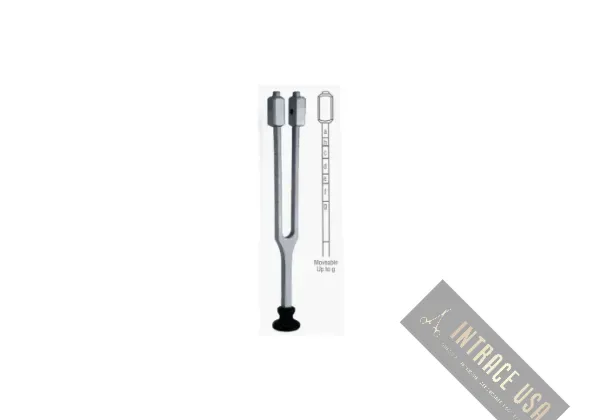
Koenig Tuning Fork
The Koenig tuning fork is a low pitched diagnostic fork. The manufacturer’s catalogue lists this pattern at 109 Hz, the note a. It also carries clamps on the prongs plus a flat foot, so you can hold it against bone as well as next to the ear.
Why a low pitch
Low frequencies are easier to feel than to hear. For that reason, clinicians often use a fork in this range to check vibration sense over bony points of the feet and hands. In addition, the foot lets you press it firmly on the mastoid or the forehead when you compare bone and air conduction.
Choosing a Koenig tuning fork
Choose this fork when you want a slow, strong vibration that lasts. By contrast, a Hartmann fork at 512 Hz suits hearing tests such as Rinne and Weber, while a Rydel-Seiffer fork adds a graded scale for scoring vibration. Many practices therefore keep one low and one mid pitch fork.
Care
Strike the Koenig fork on a rubber pad or your knee rather than a table edge, because a hard knock can shift the pitch. Then wipe the prongs and foot between patients, and store the fork in its case.
Koenig tuning fork specification
- Pitch: 109 Hz (a) in the manufacturer’s catalogue
- Clamps on the prongs
- Flat foot for bone contact
- Reusable, supplied non sterile
Warranty and supply
Every instrument carries a three year warranty against defects in manufacture, counted from the invoice date. Before an order ships, we inspect it in Atlanta. Also, for cleaning and sterilizing questions, see our FAQs, or browse the rest of our diagnostic medical instruments.
Disclaimer
Catalog photographs are reference images and may show more than one size or version, so check the option you select before ordering. This is a professional use product. Metal instruments may contain nickel, so Intrace USA cannot accept liability for allergic or material sensitivity reactions. See the FDA guidance on materials used in medical devices.

Reviews
There are no reviews yet.