




Description
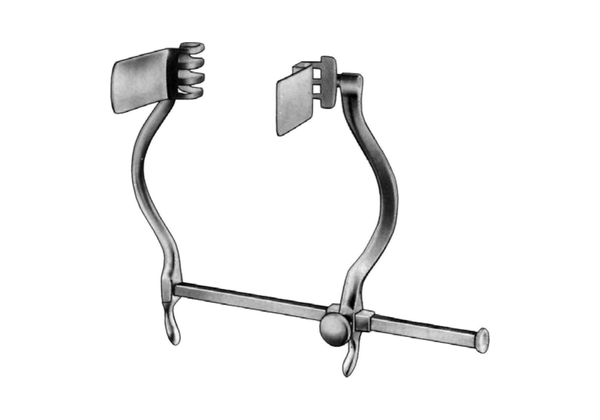
Judd-Masson Bladder Retractor
A self retaining frame built around a sliding cross bar, holding a pair of lateral blades apart at whatever opening the field needs. It is the simplest of the self retaining bladder retractors, and the simplicity is the attraction: fewer moving parts, less to seize, quicker to set.
Setting the opening
The blades run on the bar and lock where they are placed, so the retractor is set by hand rather than wound out. Four openings are catalogued, from 11 cm through to 21 cm, and the pattern is also made with a central blade added for cases that need the bladder held back as well as the wound held open.
Blades
The lateral blades are toothed on one arm and plain on the other in the standard build, which lets the toothed side take the muscle layer while the plain side sits against the softer edge. Blades swivel on their mounts so they lie flat against the tissue.
Care
Slide the blades right off the bar for reprocessing if the pattern allows it, and brush the bar and the blade mounts separately. A mount that has tightened up is usually carrying dried protein rather than damage. Dry fully, and store the frame open.
Specification
- Self retaining, sliding cross bar
- Openings: 11 cm, 16.5 cm, 18 cm, 21 cm
- Lateral blade pair, swivel mounted
- Material: surgical stainless steel
- Reusable, autoclavable, supplied non sterile
Warranty and supply
Manufacturing defects covered for three years, counted from the invoice. Stock is inspected in Atlanta before it ships. A version with a central blade is available on request. See our FAQs for care guidance, or browse the rest of our urology surgical instruments.
Further reading on open urological procedures is published by the American Urological Association.
Disclaimer
Catalog photographs are reference images and may show more than one size or variation, so check the option you have selected before ordering. This is a professional use product. Surgical stainless steel contains nickel, and Intrace USA cannot accept liability for allergic or material sensitivity reactions. See the FDA guidance on materials used in medical devices.
Reviews
There are no reviews yet.