




Description
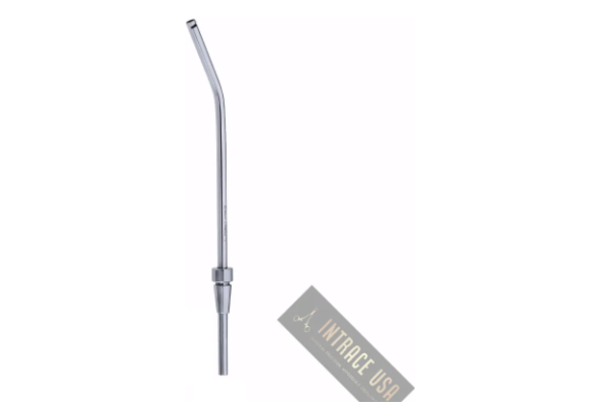
McKesson suction tube, 18 cm
The McKesson pattern is a mid-bore aspirating tube. It runs 18 cm, or 180 mm, and the catalogue lists it in three bores: 3 mm, 4 mm and 5 mm. Intrace USA supplies this McKesson suction tube in surgical stainless steel, with a knurled collar at the hub and a gently angled shaft.
Between a Frazier and a Yankauer
Most suction on a dental tray sits at one extreme or the other. A Frazier tip is fine, from 2 mm to 4 mm, and it goes into tight places. A Yankauer is broad, and it empties a mouth fast. However a great deal of oral surgery happens in between. The McKesson fills that gap. At 3 mm to 5 mm it shifts real volume, yet it is still slim enough to work inside a flap or around an osteotomy without filling the view.
That middle ground matters most when a field produces both fluid and solids. Irrigation wants a wide lumen. Meanwhile bone chips and clot want a bore that will pass them rather than trap them. A 4 mm tube does both jobs adequately, which is why it so often ends up as the default rather than the compromise.
Three bores, one length
All three sizes share the same 18 cm shaft, so the reach and the feel do not change when you switch bore. Only the opening does.
- Ø 3 mm. The finest of the three. Suits work close to a membrane or a nerve, and sites where the tube must sit still for long stretches.
- Ø 4 mm. The general-purpose size, and the one most practices stock first.
- Ø 5 mm. For heavy irrigation and debris, where clearing the field quickly matters more than finesse.
Specification
| Pattern | McKesson |
|---|---|
| Bores listed | 3 mm, 4 mm, 5 mm |
| Length | 18 cm, 180 mm |
| Shaft | Angled, knurled collar at the hub |
| Material | Stainless steel |
| Reprocessing | Autoclave before first use and between patients |
On the implant and oral surgery tray
This tube belongs on two trays: the general dental suction tray, and the implant tray beside the bone collector. Implant work is exactly the case it suits. There is irrigation from the drill, there is bone debris, and the operator needs to keep sight of an osteotomy only a few millimetres across. Similarly, third molar surgery and apicectomy both call for the same balance of flow and slimness.
Washing a mid-bore tube
A 3 mm bore is narrow enough to hold material that a rinse alone will not lift. Therefore flush the tube immediately after use, while everything inside is still wet. Then run a lumen brush the whole length, process it, and autoclave. Check the opening against the light afterwards. Dry it before it goes back, because a bore left damp is a bore that stains.
Intrace USA warrants this tube for three years against manufacturing defects.

Reviews
There are no reviews yet.