




Description
Thomson-Walker Bladder Retractor
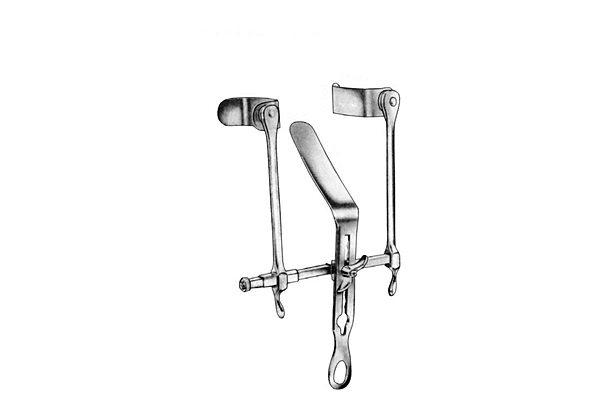
A self retaining frame for open bladder and prostate work. Two lateral blades ride on a threaded cross bar, so the opening is set by turning rather than by ratchet steps, and it holds wherever it is left.
How it holds
A screw driven cross bar gives finer control than a rack, and it will not release under load the way a ratchet can if it is knocked. That matters in a deep pelvic field where a slipped retractor costs time and exposure. The blades are carried on swivels, so each one finds its own angle against the wound edge instead of forcing the tissue to match the frame.
Where it sits among the bladder retractors
This is the screw driven option. The Judd-Masson uses a plain sliding cross bar, the Millin and Legueu patterns are ratcheted frames with ring handles, and the Kocher and Young patterns are hand held. Choose by how the field needs to be held, not by blade size alone.
Care
The thread is the part that fails. Reprocess with the frame open, brush the thread along its length, and dry it before storage. A thread that has picked up debris will feel gritty long before it seizes, and that is the moment to deal with it.
Specification
- Self retaining, threaded cross bar
- Openings: 12 cm and 14.5 cm
- Swivel mounted lateral blades
- Material: surgical stainless steel
- Reusable, autoclavable, supplied non sterile
Warranty and supply
Three years of cover against manufacturing defects, from the date of invoice. Stock is inspected in Atlanta before it ships. Other self retaining bladder retractors are stocked alongside it. See our FAQs for care guidance, or browse the rest of our urology surgical instruments.
The American Urological Association publishes background on open urological surgery.
Disclaimer
Catalog photographs are reference images and may show more than one size or variation, so check the option you have selected before ordering. This is a professional use product. Surgical stainless steel contains nickel, and Intrace USA cannot accept liability for allergic or material sensitivity reactions. See the FDA guidance on materials used in medical devices.


Reviews
There are no reviews yet.