




Description
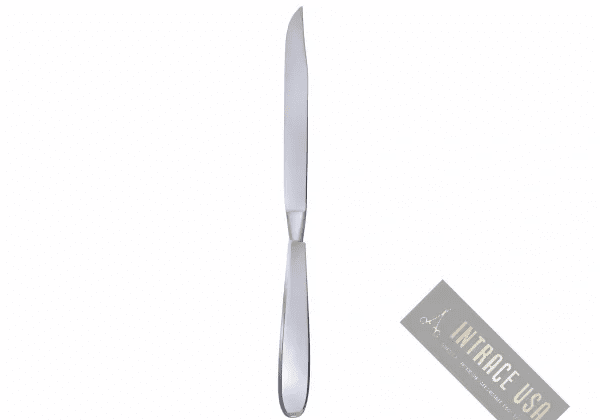
Liston Amputating Knife
The Liston amputating knife has a long, straight, single edged blade. The pattern takes its name from Robert Liston, the Scottish surgeon known for fast amputations.
A single edge for long flaps
A straight edge draws through tissue in a long stroke, so the flap edge stays clean. Because only one side cuts, the back of the blade stays safe to guide with a finger.
Choosing a length
The 18 cm knife (7 in) suits the forearm and lower leg. Meanwhile, the 20 cm (8 in) and 23 cm (9 in) lengths give reach for the thigh and upper arm. Price rises with blade length.
Care of the Liston amputating knife
Rinse and clean the blade after use. Then dry it completely and store it in a guard, since a long edge is easy to nick.
Liston, Catlin or Collin
Our category holds three amputating knife families. The Liston has a single edge, so it suits flap cutting. In contrast, the Catlin has two edges and a point for work between bones. Meanwhile, the Collin runs from 13 cm to 28 cm, which gives the widest choice of length. Also, keep the blade guard on until the moment of use. Long edges nick easily against other instruments in a tray.
Liston amputating knife lengths
- 18 cm (7 in)
- 20 cm (8 in)
- 23 cm (9 in)
- Single edged straight blade
- Stainless steel, reusable
Ordering and warranty
We give the knife three years against manufacturing defects. Before packing, an Atlanta inspection covers the full edge. For care, see our FAQs. Also, ASTM F899 describes surgical steel, and the Catlin and Collin patterns sit among our amputation knives.
Disclaimer
One photo covers all three lengths. For professional use. Stainless steel includes nickel; as a result, allergies to it sit outside our liability. The FDA explains device metals.


Reviews
There are no reviews yet.