




Description
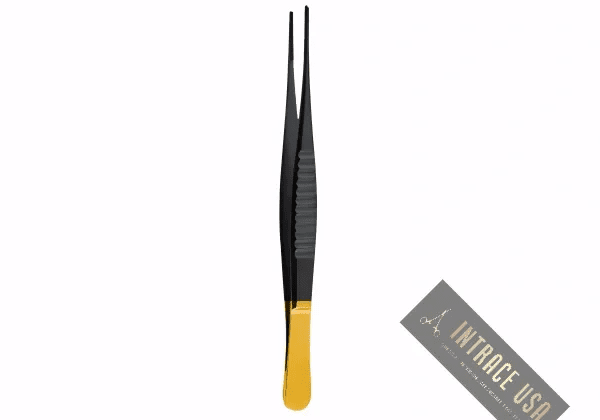
DeBakey Dissecting Forceps with Tungsten Carbide
These are the forceps a vascular surgeon holds for most of the operation. The DeBakey jaw grips a vessel wall firmly enough to present it and turn it. Fine atraumatic teeth spread the hold across the face rather than biting into it. As a result, the wall survives repeated handling through a long anastomosis and still takes a suture at the end.
Every version of this instrument is tungsten carbide. The range carries no plain-steel option. In other words, the carbide is not a premium tier bolted onto a cheaper forceps; it is how the instrument is built.
What the carbide actually does
The gripping faces carry brazed tungsten carbide inserts. Carbide is substantially harder than surgical stainless, and hardness is what preserves a tooth profile. On a plain-steel forceps the fine teeth round off with use and cleaning. Once they round, the jaw stops holding and starts sliding. Consequently the hand squeezes harder to compensate, and that is how an atraumatic instrument ends up causing trauma.
The carbide face, by contrast, keeps its edges through far more cycles. The grip it had when new is therefore the grip it still has years later. That is the whole argument for carbide on an instrument the hand picks up a hundred times in a case rather than once.
Micro and Mini profiles
Both refer to the tip. Micro is the finer of the two. Choose it for small vessels, and for fine work where a wider tip would obscure the field or take more wall than you want. Mini is a step up in tip width, giving a broader, more secure hold on vessels that will tolerate it. Neither counts as a general-purpose tip. Rather, both sit at the delicate end of the DeBakey range.
Lengths
Length is about how deep the work is, not how large the vessel is. 15 cm for superficial and peripheral work where a long shank only gets in the way. 19 cm for the general run of vascular exposure. 24 cm to reach into the chest or a deep abdominal field without the hand crowding the incision.
Key features
- Tungsten carbide inserts brazed into both jaw faces — standard, not an option
- Fine atraumatic DeBakey tooth pattern that holds vessel wall without crushing it
- Two delicate tip profiles, Micro and Mini, across three working lengths
- Serrated flats along the shanks for a controlled grip through a long case
- Autoclavable on a routine theatre cycle
Who keeps one on the tray
Vascular and cardiothoracic surgeons throughout bypass, graft and endarterectomy work; transplant teams handling donor vessels; and microvascular and reconstructive surgeons who need a fine tip that will not lose its grip over the life of the instrument.
Care
Carbide is hard but brittle. Do not use abrasive pastes or wire brushes on the jaw faces, and do not use the forceps to grip needles, wire or anything metallic — carbide chips where steel would deform, and a chipped insert cannot be dressed back. Clean between the teeth, dry fully, and inspect the inserts for chips or lifting at the braze line before each case.
Warranty
Three years against manufacturing defects.
Reviews
There are no reviews yet.