




Description
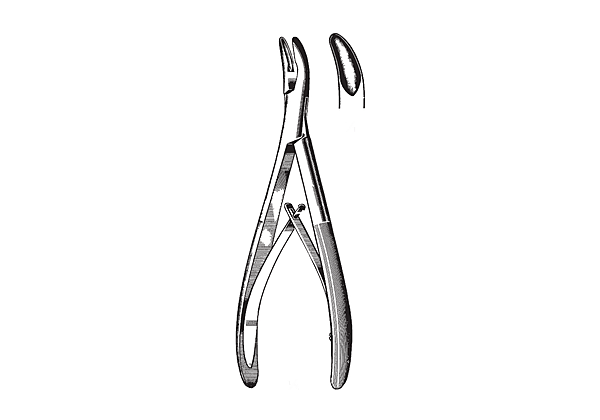
Bane Bone Rongeur Forceps
The Bane bone rongeur has a gently curved head on an 18 cm body. It shapes bone that sits just off the line of approach.
A gentle curve
Some bone surfaces sit at a small angle to the surgeon. A straight rongeur meets them on one corner, while a full curve overshoots. By contrast, a slight curve meets them evenly.
Balanced size
At 18 cm, the Bane reaches most open fields. Therefore it suits oral, hand and limb work. The cupped jaws remove bone in small, neat bites.
Who uses the Bane bone rongeur
Dentists and oral surgeons contour ridges with it after extractions. Similarly, metatarsal and metacarpal work suits it. It earns a place on general orthopedic trays too.
Using the curve
Turn the rongeur so the curve follows the bone surface. Then take small bites along the edge. As a result, the contour stays smooth.
Between straight and curved
Many sets jump from straight to strongly curved with nothing between. In that gap, the Bane offers a useful middle. Consequently, it often becomes the rongeur people reach for first.
Bane bone rongeur details
- Body length 18 cm
- Slightly curved head
- Cupped jaws
- Ships non-sterile
Caring for the Bane
Brush the curved cups from both sides to clear debris. Rinse and dry. Then lubricate the hinge and close the jaws for storage.
Buying from us
Your guarantee for this rongeur spans three years against manufacturing defects by default. Before it ships, our Atlanta inspector assesses the Bane rongeur in person. For quick answers, read our order FAQ. The FDA recognizes ASTM F899 for stainless steel in surgical tools. Larger surgical teams keep a spare rongeur for busy lists. Visit our whole orthopedics department for more. Surgeons often add our Blumenthal rongeur. We readily check stock within a day or so.
For trained clinical staff only. Exchange terms are on our returns terms. Gallery shots show a typical piece, and the alloy includes nickel; open the care and sterilization guide for more.

Reviews
There are no reviews yet.