




Description
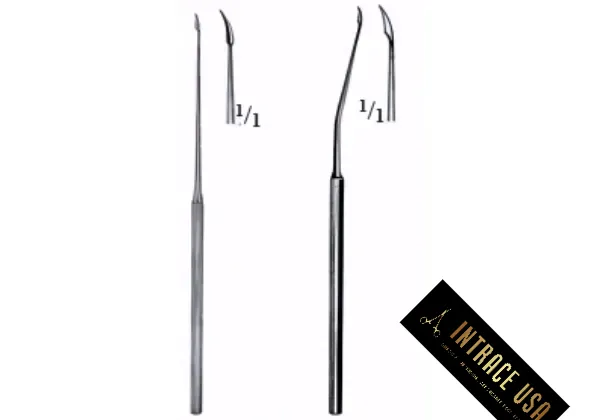
Schuknecht Needle
The Schuknecht needle is a slender angled point for middle ear surgery. Otologists use it to dissect, probe and position tissue under the microscope.
Why angled needles
Many middle ear structures sit behind the edge of the ear canal. A straight needle cannot always reach them. So an angled tip lets the surgeon work around a corner while keeping the shaft in view.
Forty combinations
Choose a tip of 0.2, 0.4, 0.6, 0.8 or 1 mm. Next, pick a 45 or 90 degree angle. Then select the direction: up, down, left or right. That gives 40 options, each roughly 16.5 cm long by our catalogue.
In ear surgery
Surgeons use needles like this during stapes surgery and tympanoplasty. For instance, they may free adhesions or lift a graft edge. A set of angles and directions lets them reach in every direction around the ossicles.
Building a set
Few surgeons need all 40 versions. Instead, start with a 45 degree needle in two directions and a 90 degree needle in two directions. Then add tip sizes to suit your technique.
Caring for your Schuknecht needle
Protect the tip at every step, since fine points bend easily. Clean the needle gently with a soft brush, then rinse and dry it. Store and sterilize it in a tray with tip protection.
Specifications
- Tips: 0.2, 0.4, 0.6, 0.8 or 1 mm
- Angle: 45 or 90 degrees
- Direction: up, down, left or right
- Length: about 16.5 cm
- Stainless steel
Buying Schuknecht needles
A three-year warranty protects this needle from defects due to workmanship. Also, our Atlanta staff check each point under good light before packing. Our FAQ help page answers questions about mixed orders. ASTM F899 sets out the steels we use as a benchmark for surgical instruments. For a knife in the same style, see the Zollner ear knife. More choices sit in our ENT microsurgery range.
Professional use only. Our care and handling guide explains how photos relate to products and why steel contains nickel; the returns page covers exchanges.

Reviews
There are no reviews yet.