
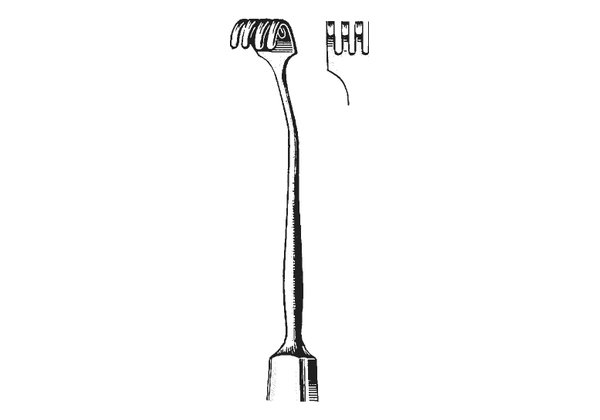




Description
Fink Hook, 4 Prong
The Fink hook 4 prong gives you a wide, even hold on skin and soft tissue. Four prongs share the pull, so the edge stays open without bunching. It comes as one pattern that slots into a lid or lacrimal set.
Four prongs, one steady edge
A single hook pulls on one point. By contrast, four prongs spread that pull across the edge. As a result, the tissue opens more evenly and is less likely to tear. That matters when you work on thin lid skin or around the lacrimal sac.
Typical Fink cases
Pronged retractors often appear in lid and lacrimal surgery. For example, an assistant can hold the Fink to keep the wound open while you dissect. It also pairs well with a second pronged hook on the far edge. Then you get an open, square field.
Holding the Fink well
- Seat all four prongs before you pull.
- Pull back along the line of the wound.
- Keep the pull steady rather than jerky.
- Shift the hold if the skin starts to blanch.
Brushing between four prongs
Four prongs mean more spots for tissue to hide. So hold the hook under cool water and brush between each prong with a small nylon brush. A short ultrasonic run also helps. Dry it with care. The Fink is supplied non-sterile, so sterilize it before its first lid case. From then on, it is reusable.
Fink warranty and partner tools
This Fink retractor is backed for three years against manufacturing defects, prongs and all. Our steel is in line with ASTM F899. See the ophthalmic retractor collection for more choices, or compare the Knapp-Rollet hook with its prong options. Our questions page helps with orders.
Fink hooks are for trained clinical users. Check our Fink cleaning steps and delivery details.


Reviews
There are no reviews yet.