
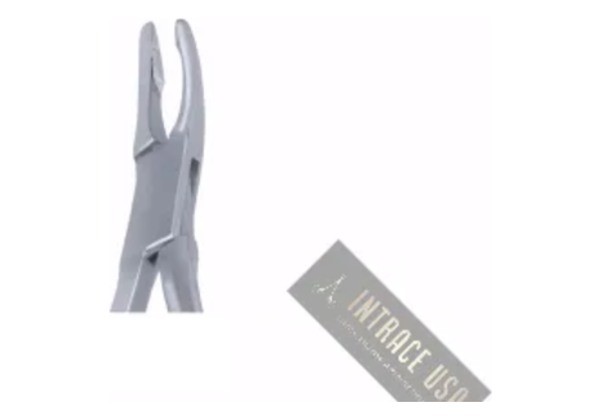




Description
Bone Rongeurs, Straight
Most catalogues list a dozen specialised rongeurs and one unmarked pattern. This is the unmarked one, and for most practices a plain dental bone rongeur is the first of the family worth owning. There is no angle to work around, no flank grind to think about and no compound hinge to look after. The jaws meet at the tip and take a bite, which turns out to be what the majority of cases actually call for.
What a plain dental bone rongeur does best
Straight jaws closing at the tip give the most predictable bite of any pattern, because nothing in the geometry alters what happens when you squeeze. Consequently this is the instrument people reach for when the job is ordinary: a rough margin after an extraction, a spicule that catches a fingertip, a ridge that wants taking down slightly before the flap goes back. Specialised beaks earn their keep on awkward approaches. This one earns its keep on volume.
Key measurements
- 16.5 cm overall, near enough 6½ inches
- Straight jaws meeting at the tip
- Single action, with a leaf spring that reopens the handles
- Knurling along the grip rather than a polished shank
- Inspected in Atlanta, Georgia before it leaves us
Where it turns up most
It lives on oral surgery setups and general extraction trays, and it tends to be the rongeur a practice owns two of rather than one. Meanwhile podiatry and small-bone clinics use the same pattern for nail bed and phalangeal work. If the approach is genuinely awkward, our bone rongeur range covers side-cutting, curved and double-action beaks that reach where a straight tip cannot.
Service life
Because this pattern gets used more than the specialised ones, it wears faster, and that is worth planning for rather than resenting. Watch the tips for a gap when closed, since a rongeur that no longer meets cleanly crushes bone instead of cutting it. Otherwise the routine is unremarkable: clean before anything dries, lubricate the joint, autoclave, and store it with the handles open.
Guaranteed for three years against manufacturing defects.

Reviews
There are no reviews yet.