




Description
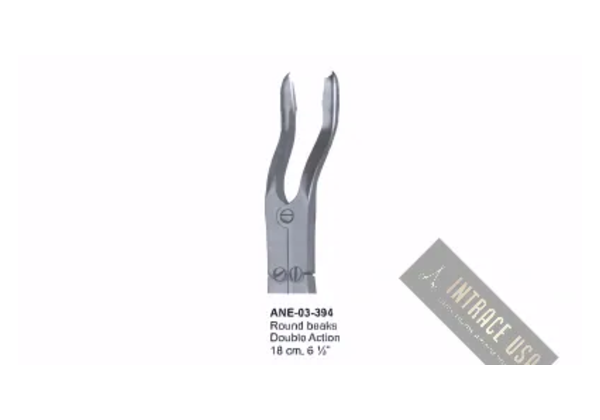
Double Action Bone Rongeurs, Round Beaks
A double action bone rongeur places two hinges between the hand and the bite, and that second pivot changes how the instrument behaves. Because the compound lever multiplies closing force, the beaks travel through dense cortical bone while the hand stays inside a comfortable part of its range. As a result the surgeon squeezes less and removes more, which matters most on the last few bites of a long case, when fatigue quietly turns into imprecision.
What the second hinge actually buys
Single-action patterns are direct and quick, so many surgeons still prefer them on soft cancellous bone. However, the harder the bone, the more the effort shows up in the wrist. This pattern trades a little speed for a great deal of control, and in practice that trade is worth making whenever a cut has to be repeated twenty times rather than twice.
Round beaks, and why they are not cutting beaks
The beaks on this instrument are round, so they lift and contour rather than shear. A side-cutting or straight beak is built to take a clean edge off bone; a round beak scoops instead, leaving a rounded surface behind rather than a facet. Therefore this is the pattern reached for when bone needs shaping, smoothing or reducing to a contour, not dividing.
Dimensions and build
- Overall length 18 cm (7″)
- Round beaks on a double-action compound hinge
- Serrated finger grips with a return spring
- Satin finish, which cuts glare under the operating light
- Inspected in Atlanta, Georgia before it ships
Where it earns its place on the tray
Oral and maxillofacial surgeons reach for it during alveolar contouring and tuberosity reduction. Meanwhile podiatric, hand and small-bone orthopaedic teams keep one to hand for much the same reason: at 18 cm it reaches comfortably without becoming unwieldy, and the round beak finishes a surface that a cutting beak would leave sharp. Browse the rest of our bone rongeurs for straight, side-cutting and eponymous patterns.
Cleaning and upkeep
Rinse and brush the hinge while debris is still wet, since dried bone dust inside a compound joint is what stiffens these instruments first. Afterwards, lubricate both pivots and work the handles open and closed a few times before autoclaving. Although the return spring is robust, storing the instrument closed under tension will shorten its working life, so rack it open.
Every Intrace USA instrument carries a three year warranty against manufacturing defects.

Reviews
There are no reviews yet.