




Description
Cleveland Bone Rongeurs
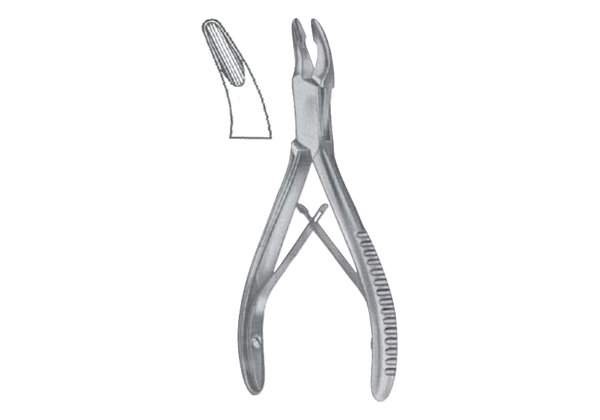
The Cleveland bone rongeurs are one body in seven jaw figures. Handle, spring and joint are common to all of them, so what the figure number really tells you is where the beak points and how much bone it takes. Pick the figure first; the length follows from it.
Front cutting or side cutting
This is the decision that matters. Figures 3, 4, 4 A and 10 bite at the tip, so the beak goes where the shank points and you work straight at the bone. Figures 5, 5 A and 5 S turn the beak across the axis of the handle instead. Consequently a side-cutting figure reaches bone lying along a wall — a buccal plate, the inside of a socket — without swinging the handle into the cheek. Front cutting is the more direct of the two; side cutting is what you want when the approach comes in from one side.
The seven figures of the Cleveland bone rongeurs
- Fig. 3 and Fig. 4 — 14 cm, the short pair, differing in beak profile
- Fig. 4 A — 17 cm, the same idea with more reach
- Fig. 5 and Fig. 5 A — 17 cm, side cutting
- Fig. 5 S — 15 cm, side cutting, and the shortest of those three
- Fig. 10 — 17 cm
All seven carry the same price, so the choice stays a clinical one.
Key features
- Seven jaw figures on a single handle pattern, front cutting and side cutting
- Cupped beak with a sharpened rim, for a bite of a known size
- Leaf spring in the handle, returning the beak between cuts
- Box-jointed head rather than a lap joint
- Cross-milled grip panels along both handles
- Stainless steel throughout, and autoclavable
On the oral surgery tray
Most surgeons keep two or three figures rather than one: a short front-cutting figure for the socket, a side-cutting figure for the plate, and something longer when the field is deeper. Periodontists use the same figures through osseous surgery. Because they share a handle, a practice that standardises on the Cleveland bone rongeurs gets the same feel from every one of them.
Care
Bone packs into the cup and behind the joint, so rinse before it dries and brush the beak by hand rather than trusting the washer. Then close the instrument slowly and watch the two halves meet: they should touch along the whole edge, and a figure that no longer does is crushing instead of cutting. Never put one away compressed, since a leaf spring held shut loses its return.
Warranty
Three years against manufacturing defects.

Reviews
There are no reviews yet.